
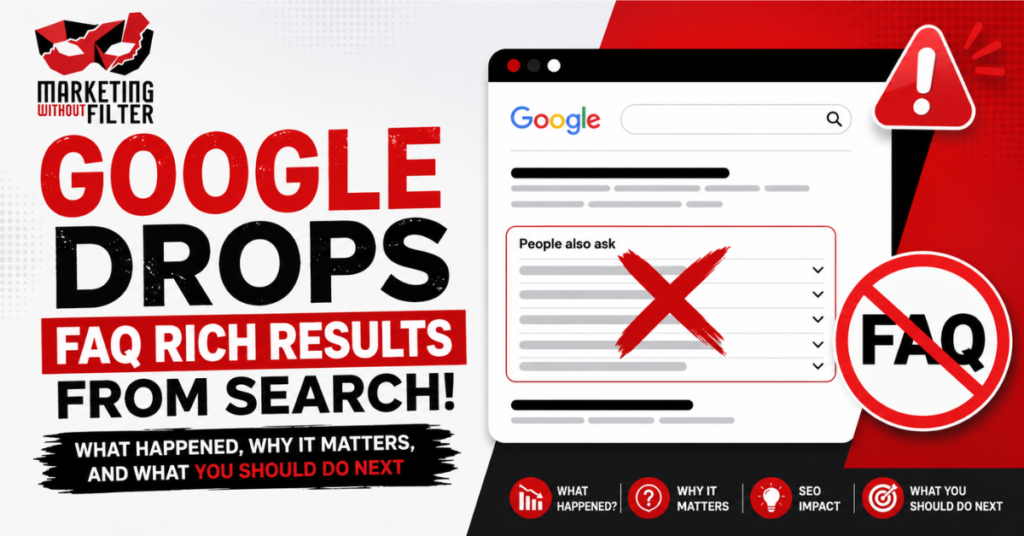
One morning in early May 2026, SEOs opened their Search Console dashboards and noticed something was missing. Those neat accordion-style FAQ dropdowns that used to appear right beneath search listings? Gone. No warning email. No fanfare. Just a quiet deprecation notice tucked into Google’s structured data documentation.
If you’ve been using FAQ schema to grab extra SERP real estate, this update hits directly. Google officially removed FAQ rich results from search on May 7, 2026, completing a gradual three-year withdrawal that most site owners never fully tracked.
This isn’t a minor tweak. It’s the end of a feature that gave websites free visibility boosts — and it signals something bigger about where Google’s search experience is heading.
Here’s everything you need to know: what happened, why it happened, and what to do about it.
What Are FAQ Rich Results?
For anyone newer to structured data, let’s get on the same page.
FAQ rich results were enhanced search listings that displayed a series of expandable questions and answers directly on the Google results page. When a site used FAQ-Page schema markup — a type of structured data from Schema.org — Google could pull those Q&A pairs from the page and display them right in the SERP, without the user even clicking through.
You’ve almost certainly seen them. A blue link for a brand’s homepage, followed by three or four clickable questions like “How does shipping work?” or “What is your refund policy?” — all sitting right there below the main result.
Why They Were Important for SEO
FAQ rich results weren’t just cosmetic. They were a legitimate competitive weapon. Pages with FAQ schema often occupied significantly more vertical space in search results, pushing competitors further down the page without earning a higher ranking.
They also answered user questions at the snippet level, which sounds counter-intuitive for driving traffic — but it built brand authority and primed users to click for more depth.
Real Benefits: CTR, SERP Space, and Authority
- Increased SERP real estate: A single result could dominate the top of the page with 3–4 expanded questions, effectively crowding out the #2 and #3 positions visually.
- Higher click-through rates (CTR): Research consistently showed that rich results attract more attention and clicks than standard blue links.
- Trust signals: Showing answers directly in search results positioned brands as helpful experts, reinforcing EEAT signals even before a user landed on the page.
- Featured snippet competition: For informational queries, FAQ results competed directly with featured snippets for above-the-fold attention.
For content-heavy sites — legal, healthcare, SaaS, and ecommerce especially — FAQ schema was a high-ROI implementation that required minimal technical lift.
Google Drops FAQ Rich Results – What Happened?
There was no blog post. No Google Search Central announcement. Just a deprecation notice quietly added to Google’s FAQ structured data documentation that read:
Here’s the full removal timeline:
May 7, 2026 — FAQ rich results stop appearing in search. This is when the visible change happened. If you noticed a drop in SERP features in your GSC impressions data around this date, this is why.
June 2026 — Search Console reporting is removed. The FAQ search appearance filter, the rich result report, and Rich Results Test support for FAQ schema will all be deprecated.
August 2026 — API support ends. Teams using the Search Console API to pull FAQ performance data have until August to update or retire those integrations.
The FAQ schema markup itself — the code on your pages — still works from a technical standpoint. Google just won’t display it as a rich result anymore.
Why Did Google Remove FAQ Rich Results?
Google offered no official explanation, but if you’ve been watching search evolve over the past few years, the writing has been on the wall.
The spam problem got out of hand. Once FAQ schema became a known CTR booster, it spread everywhere — often with zero relevance to the page’s actual content. Product pages with generic “FAQ” blocks slapped on just for rich result eligibility became common. The signal-to-noise ratio collapsed.
AI Overviews changed the game. Google’s AI-generated summaries at the top of results already do what FAQ schema promised to do: synthesize answers and present them in a clean, structured format. There’s significant functional overlap. Why display a brand’s manually curated FAQ accordion when the AI can synthesize a better answer from across the entire web?
UX was getting cluttered. SERPs were becoming overwhelming. Between featured snippets, People Also Ask boxes, AI Overviews, local packs, shopping carousels, and FAQ drop-downs, the results page was turning into a crowded billboard. Google has been streamlining its SERP design, and FAQ rich results didn’t survive the cut.
The shift toward zero-click answers. This is the big one. Google has been systematically moving toward answering questions directly in search rather than sending traffic to websites. FAQ schema, ironically, helped accelerate that behaviour. Removing it from the display layer is one part of that broader repositioning.
This is consistent with what we saw in August 2023, when Google first restricted FAQ rich results to government and health sites only, and deprecated How To rich results on mobile at the same time. The full removal in May 2026 ended eligibility even for those remaining exceptions.
Impact on SEO & Websites
Let’s be straight: this matters, but it’s not a traffic catastrophe for most sites.
Impressions in Search Console will drop. If you were measuring FAQ schema performance through GSC impressions (which counted every time a rich result appeared), expect that number to fall noticeably. This is a reporting artifact, not a rankings drop. Organic position is unaffected.
CTR changes are real but modest. Sites that relied heavily on FAQ dropdowns for click-through likely saw a small dip in CTR on pages where those results were appearing. The organic listing still shows — it just no longer has the extra dropdown rows beneath it.
SERP visibility has consolidated. Without the expanded FAQ block, your listing now looks like everyone else’s. That’s the real competitive loss — not a penalty, but the erasure of an advantage.
Health and government sites feel this most. For most commercial websites, FAQ rich results had already been stripped away since 2023. But official government agencies and health authorities were still seeing FAQ dropdowns until May 7. Their SERP footprint has meaningfully shrunk.
Developer and agency teams need to update their reporting. Any dashboard or reporting pipeline that pulls FAQ rich result data from the Search Console API needs to be updated before August. After that, the API support disappears entirely.
The good news? No page has been penalized. Organic rankings are not affected by this change. It’s a display removal, not an algorithmic demotion.
Should You Remove FAQ Schema Now?
Short answer: No. Don’t rush to remove it.
Google has been clear that unused structured data doesn’t cause any problems for search performance. The FAQPage schema type is still a valid Schema.org vocabulary, and the markup itself isn’t going anywhere.
There are also emerging reasons to keep it. Some in the SEO community have noted that FAQ schema — with its clear question-and-answer structure — may help AI systems better parse and understand page content. Whether that translates into better AI Overview citations or better answers in AI-native search engines like Perplexity is still being studied, but the logic is sound.
If you have FAQ schema implemented cleanly and accurately on relevant pages, leave it. If it’s keyword-stuffed garbage that was implemented purely for the rich result, now’s a good time to clean it up — not because Google will penalize it, but because messy structured data is always a liability.
The one thing to do now: remove FAQ schema tracking from your rich result reporting dashboards, since those reports will disappear in June. Don’t confuse the loss of the report with a loss of ranking.
What Should You Do Instead?
The disappearance of FAQ rich results isn’t a reason to panic. It’s a prompt to double down on the strategies that matter in 2026’s search landscape.
Focus on Topical Authority
Google’s Helpful Content System rewards sites that cover topics comprehensively and with demonstrable expertise. Instead of scattering thin FAQ blocks across product pages, build dedicated resource hubs that go deep on the questions your audience is actually asking.
A single well-researched pillar page that thoroughly covers a topic will outperform a dozen pages with tacked-on FAQ schema every time. Internal links, cluster content, and semantic coverage of related subtopics — these are the building blocks of topical authority that FAQ dropdowns were never designed to replace.
Optimize for AI Search (AEO)
Answer Engine Optimization is becoming as important as traditional SEO. AI Overviews, ChatGPT, Perplexity, and Gemini are all pulling answers from web content — and the pages they favor are structured, clear, and authoritative.
Write content that directly answers questions in the first paragraph. Use clear headings that mirror natural language queries. Make your answers self-contained enough that an AI can extract and attribute them accurately.
The irony is that the best AEO practices look a lot like good FAQ content — clear questions, concise answers, logical structure. The only difference is that you’re optimizing for AI extraction, not schema-triggered display boxes.
Use Other Schema Types
FAQ schema isn’t the only game in town. Depending on your industry and content type, other structured data types remain fully supported and actively generate rich results:
- HowTo schema — still works for desktop (though mobile was deprecated in 2023)
- Article and NewsArticle schema — supports byline display and Top Stories eligibility
- Product schema — price, availability, and review stars in ecommerce results
- Review and AggregateRating schema — star ratings in SERP snippets
- Event schema — event cards with date, location, and registration info
- Speakable schema — increasingly relevant for voice and AI assistant results
Don’t abandon structured data. Redirect that effort toward schema types that still produce visible SERP enhancements.
Improve Content Depth
This is the one that lasts. Rich results come and go — Google has deprecated dozens of them over the years. What doesn’t change is Google’s preference for content that genuinely helps people.
Long, researched content that answers follow-up questions. Content that anticipates objections. Content written by people who actually know the subject. This is what earns featured snippets, AI Overview citations, and durable organic rankings regardless of which schema feature Google decides to sunset next.
If FAQ schema was doing any real SEO work for you, it’s because the underlying content was solid. Build on that foundation.
Future of SEO After This Update
The removal of FAQ rich results is one data point in a much larger shift.
Google is actively designing a search experience where fewer users need to click through to websites. AI Overviews answer general questions directly. Local packs handle near-me queries. Shopping listings aggregate product comparisons. The organic blue link — the foundation of SEO for 25 years — is being progressively compressed.
This doesn’t mean SEO is dead. It means the game has changed.
Entity SEO is becoming more important. Google increasingly understands entities — people, places, products, concepts — and their relationships to each other. Being clearly recognized as an authoritative entity in your niche (through structured data, Wikipedia presence, knowledge panel signals, and consistent brand mentions across the web) is a competitive moat.
Zero-click optimization is a real discipline now. Winning the featured snippet or AI Overview isn’t always about getting the click — it’s about getting the attribution. That brand impression still has value, even if the user never visits your site.
First-party content will matter more, not less. As AI commoditizes surface-level information, original research, unique perspectives, case studies, and proprietary data become the scarcest and most valuable content assets. Sites that invest in producing content no AI can synthesize — because it doesn’t exist anywhere else — will win.
The next evolution of SEO isn’t about outsmarting algorithms. It’s about being genuinely useful in a world where algorithms are getting better at spotting the difference.
Expert Insight
At Marketing Without Filter, we’ve been tracking this shift since Google first quietly pulled back FAQ rich results in April 2023. What struck us then — and what’s even clearer now — is that the sites that panicked and over-engineered their schema were the same ones that benefited least from it.
The brands that built real FAQ content tied to genuine customer questions, with answers that actually helped — those brands saw CTR lifts, saw AI systems cite their pages, and will continue to see results because they were doing the underlying work correctly.
The schema was always just a wrapper around the content. Now the wrapper is gone. The content still matters just as much.
Our advice to every client we work with: stop chasing display features and start building the content infrastructure that makes your site the obvious answer, regardless of how Google chooses to display it.
Conclusion
Google dropping FAQ rich results from search is a clear signal that the SERP landscape is being redesigned around AI-first experiences. This particular feature is gone, and it’s not coming back.
But the fundamentals haven’t changed. Content that clearly answers questions, structured logically, written by people who know what they’re talking about — that content wins in 2026 just as it did in 2016.
The strategic takeaway: Don’t remove FAQ schema in a panic. Do audit whether your FAQ content is genuinely useful or just schema-stuffed filler. Redirect your structured data energy toward schema types that still produce rich results. And invest in topical authority and AEO as your primary visibility strategies going forward.
The sites that will suffer from this update are the ones that were relying on the display trick instead of the content quality underneath it.
FAQs
Q: Did Google penalize sites using FAQ schema?
No. This was a display feature removal, not an algorithmic penalty. Pages using FAQ schema have not been demoted in rankings. The schema simply no longer triggers rich result dropdowns in search.
Q: Should I remove FAQ schema from my website?
There’s no urgent need to. Google has confirmed that unused structured data doesn’t harm search performance. If your FAQ schema is well-implemented and accurate, you can safely leave it in place. If it’s spammy or irrelevant, clean it up for general quality reasons.
Q: Will FAQ schema help with AI Overviews or AI search engines?
Possibly. The structured question-and-answer format of FAQPage schema may help AI systems extract and attribute content more accurately. This isn’t confirmed by Google, but the logic is sound. It’s one reason to keep clean, relevant FAQ schema on your pages.
Q: When will Search Console stop showing FAQ data?
Google will remove the FAQ appearance filter, rich result report, and Rich Results Test support in June 2026. Search Console API support for FAQ data will end in August 2026.
Q: What schema types still produce rich results in Google Search?
Many schema types remain active and supported, including Product, Review, Article, Event, Breadcrumb, Site-links Searchbox, HowTo (desktop only), and Speakable. Check Google’s Search Gallery in the developer documentation for the full current list.